Standing on the dealership lot last month, staring at a brand-new vehicle with a $50,000 sticker price, I felt the familiar knot in my stomach. The salesperson held a clipboard featuring two distinct columns of numbers, waiting for me to make a choice that would impact my monthly budget for years. Car prices have stabilized somewhat since the wild fluctuations of the early 2020s, but interest rates and residual values have shifted dramatically. I realized right then that relying on outdated automotive advice could cost me thousands of dollars, pushing me to critically evaluate every aspect of this massive financial commitment.
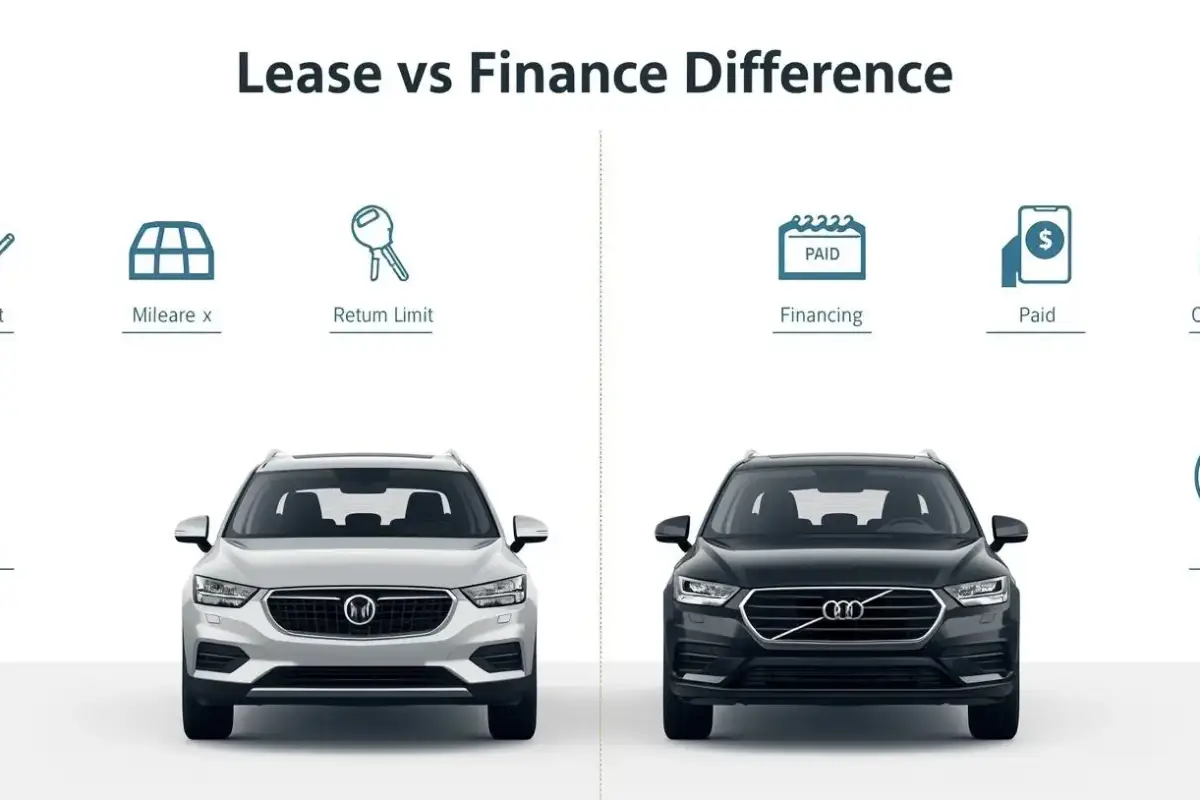
Lease vs finance is the exact dilemma that traps countless buyers into paying far more than they should. When you lease, you essentially rent the vehicle for a fixed period, paying only for the depreciation that occurs during those specific years. When you finance, you take out a loan for the entire purchase price of the car, slowly building equity until you own the machine outright. Making the right call requires looking past the shiny exterior of the car and diving deep into your own driving habits, financial goals, and long-term plans.
Decoding the Monthly Payment Illusion
The first trap I always notice buyers falling into when weighing the lease vs finance question involves the monthly payment amount. Dealerships love to highlight the leasing option because the monthly payment almost always looks significantly lower than a traditional auto loan. You might see a $500 monthly lease payment sitting next to an $850 financing payment for the exact same vehicle, making the lease feel like an absolute bargain. However, focusing solely on this immediate cash flow difference hides the true cost of the transaction over a five- or ten-year horizon.
Looking closer at the lease vs finance breakdown, I realized that the lower lease payment offers zero return on investment once the contract ends. You make those lower payments for thirty-six months, hand the keys back to the dealer, and walk away with absolutely nothing to show for your money. Financing requires a heavier burden on your monthly budget upfront, but every payment chips away at the principal balance of your loan. After the loan term finishes, you possess a tangible asset with real cash value that you can trade in or sell privately.
Also Read: Bad Credit Financing for ATV: Get Approved in 24 Hours Even With Low Score
When I ran my own lease vs finance calculations, I had to factor in my personal cash flow requirements. If tying up an extra $350 a month in a car payment would prevent me from investing in my retirement or paying down high-interest credit card debt, the lower lease payment suddenly makes more strategic sense. I learned to never look at the car payment in a vacuum, but rather as one shifting piece of a much larger personal finance puzzle. A lower payment only helps if you purposefully redirect those saved funds toward something that builds actual wealth.
Another crucial factor in the lease vs finance debate involves the required down payment or drive-off fees. Leases often advertise zero-down specials, but reading the fine print usually reveals hidden acquisition fees, first month’s payments, and security deposits due at signing. Financing generally requires a more substantial true down payment to secure a favorable interest rate and keep the loan from going upside down immediately. I found that bringing significant cash to the table drastically altered the math in favor of traditional purchasing.
Ultimately, navigating the monthly payment aspect of the lease vs finance equation requires ruthless honesty about your spending habits. I had to ask myself if I genuinely preferred driving a newer car every three years, or if I valued the financial freedom of eventually having no car payment at all. Dealerships design their pricing structures to make leasing look incredibly attractive, so you must bring your own calculator and run the numbers across a full decade to see the absolute truth.
Navigating Mileage Limits and Lifestyle Changes
A major component of my lease vs finance decision came down to how I actually use my vehicle on a daily basis. Leasing contracts come with strict mileage limitations, typically ranging from ten thousand to fifteen thousand miles per year. If you exceed these boundaries, the leasing company will penalize you with hefty per-mile charges at the end of your term. I knew that my commute, weekend road trips, and occasional long-distance family visits could easily push me dangerously close to those strict boundaries.
Also Read: GMC Financing Deals Today: Unlock 0% APR Offers Before They Disappear
When evaluating the lease vs finance options based on driving habits, financing clearly offers total freedom of movement. Once you sign a traditional auto loan, the bank holds the title, but nobody monitors your odometer or cares if you drive cross-country three times a year. I loved the idea of taking spontaneous road trips without doing mental math to figure out if I was violating a binding contract. If you have an unpredictable commute or simply love to drive, the constraints of a lease can quickly become a source of massive anxiety.
The lease vs finance conversation also forces you to think about how well you maintain your belongings. Leasing companies expect the car to be returned in excellent condition, allowing only for normal wear and tear. If you have messy pets, rowdy children, or simply treat your vehicle like a mobile locker room, you will face steep reconditioning fees when you hand the keys back. Financing forgives your spills, dents, and scratched bumpers, as the only person you ultimately answer to regarding the vehicle’s condition is yourself.
I had to project my lifestyle three years into the future to accurately settle my own lease vs finance dilemma. Life changes fast, and a compact sedan that perfectly fits a single professional might become completely inadequate if you start a family or launch a business requiring cargo space. Breaking a lease early is notoriously difficult and incredibly expensive, often leaving you responsible for the remaining payments anyway. Financing gives you the flexibility to sell or trade the vehicle whenever your life circumstances demand a change, even if you still owe money on the loan.
Ultimately, the lifestyle aspect of the lease vs finance choice boils down to predictability versus flexibility. I realized that my life in 2026 felt far too dynamic to lock myself into a rigid three-year box with strict mileage caps. However, a friend of mine who works from home and drives exactly four thousand miles a year finds leasing perfectly suited to his highly predictable routine. You must accurately audit your driving habits before deciding which path aligns with your actual reality.
Also Read: Co Financed Deals Revealed: How to Split Big Investments and Double Returns Without Risk
The Reality of Maintenance and Warranties
Stepping into the service department highlighted another vital layer of the lease vs finance discussion. When you lease a new car, your entire term generally falls under the manufacturer’s bumper-to-bumper warranty. If the transmission slips, the infotainment screen goes black, or the air conditioning fails, you simply drop the car at the dealership and let them fix it for free. I found this peace of mind incredibly enticing, as unexpected repair bills can completely derail a carefully planned monthly budget.
However, examining the lease vs finance reality means acknowledging what happens as a vehicle ages past that protective warranty period. Buyers who finance their cars eventually cross the threshold where the factory warranty expires, leaving them entirely responsible for mechanical failures. I knew that keeping a financed car for eight years meant I would eventually need to pay for new brakes, timing belts, and potentially expensive electronic repairs out of my own pocket. You have to actively build a maintenance fund if you plan to keep a vehicle for the long haul.
The lease vs finance debate takes an interesting turn when you factor in routine maintenance like oil changes and tire rotations. Many modern lease agreements actually include complimentary routine maintenance for the first two or three years. This perk effectively reduces your vehicle operating costs strictly to gas and insurance during the lease term. When you finance, even if you get a short complimentary maintenance period, you will eventually bear the full cost of every drop of oil and every new set of tires.
Yet, as I dug deeper into my personal lease vs finance analysis, I realized that the fear of out-of-pocket repairs often pushes people into bad financial decisions. Modern vehicles, when properly maintained, regularly surpass one hundred and fifty thousand miles without catastrophic failures. Yes, you will pay for repairs on a financed car in year six, but those repair costs rarely equal the price of perpetually carrying a five-hundred-dollar monthly lease payment. I had to overcome my fear of the mechanic’s shop to see the long-term mathematical advantage of ownership.
Also Read: Peace Finance Explained: Powerful Ways Ethical Money Strategies Build Wealth in 2026
Weighing warranties in the lease vs finance decision requires balancing emotional comfort against mathematical reality. I loved the idea of never worrying about a breakdown, which leasing absolutely provides. But I also recognized that setting aside a small fraction of what I would save by eliminating my car payment after five years would easily cover any future repairs. Understanding this dynamic helped me approach the finance office with a clear, logical mindset rather than acting out of fear.
Long-Term Wealth and Asset Management
The final piece of my puzzle involved zooming out and looking at the lease vs finance question through the lens of long-term wealth building. Cars are notoriously terrible investments because they depreciate rapidly the moment you drive them off the lot. However, how you manage that depreciating asset plays a massive role in your overall financial health over a lifetime. I started viewing my $50,000 car decision not just as a transportation choice, but as a capital allocation problem.
When you look at a lifetime of driving, the lease vs finance outcome becomes starkly clear. If you lease a new car every three years from age twenty-five to age sixty-five, you will make four hundred and eighty consecutive car payments. You guarantee that a significant portion of your monthly income will forever belong to an automotive financing company. I found this perpetual payment cycle terrifying, as it actively drains resources that could otherwise compound in a retirement account or real estate investment.
Choosing ownership in the lease vs finance scenario offers an eventual escape route from the payment cycle. If you finance a car for five years and drive it for ten, you enjoy five glorious years without any car payment at all. I calculated that taking my hypothetical $850 finance payment and investing it in an index fund during those five payment-free years would yield tens of thousands of dollars in wealth. This strategy transforms the car from a permanent financial drain into a temporary hurdle on the path to financial independence.
Also Read: Term Finance Certificate Secrets: How Smart Investors Turn Paper Into Passive Income Fast
Of course, the lease vs finance wealth equation assumes you actually keep the financed car after paying it off. I know too many people who finance a car for sixty months, get bored in month fifty-nine, and immediately trade it in for another brand-new vehicle. If you treat financing like a slow, expensive lease by constantly rolling into new loans, you absorb the worst depreciation hits without ever enjoying the payment-free years. You have to commit to driving the paid-off asset to actually reap the financial rewards.
Ultimately, my personal lease vs finance decision came down to taking control of my future cash flow. I realized that writing a check to the bank every single month for the rest of my life simply to have a shiny new dashboard wasn’t worth the sacrifice. By choosing to finance and holding onto the vehicle, I accepted higher upfront costs in exchange for future financial liberation. It is a delayed gratification strategy that requires discipline, but the long-term math undeniably supports ownership for those willing to commit.
Conclusion
Navigating the dealership floor and making a $50,000 commitment requires pushing past the glossy brochures and aggressive sales tactics. By thoroughly analyzing my driving habits, my maintenance risk tolerance, and my long-term wealth goals, I managed to cut through the confusion and make a logical choice. You have to look at the numbers stretching across an entire decade, rather than just focusing on the immediate impact on your checking account this month.
Ultimately, mastering the lease vs finance decision comes down to knowing yourself and prioritizing your financial future over immediate luxury. While leasing offers undeniable convenience and short-term budget relief, traditional financing provides a concrete path to eliminating debt and owning a valuable asset. Take the time to run your own calculations, assess your lifestyle honestly, and you will drive off the lot confident that you made the right financial choice for your unique situation.
Also Read: Mastering Personal Finance Tips for Young Adults: A Guide to Financial Freedom